
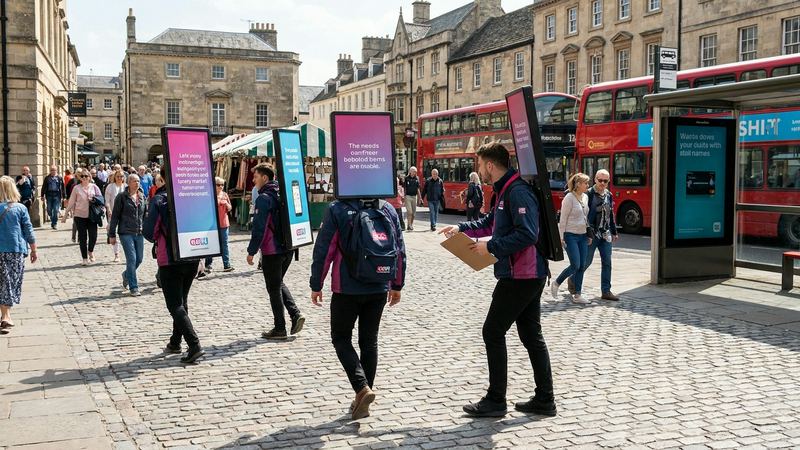
Adwalkers: Walking Billboards in the UK
Adwalkers are people who carry a billboard through a town centre. What the format is, where it is used in the UK, what a buyer should ask about staffing, routes and permissions, and how it compares wi...
Ambient media, street-level formats, experiential work and the odder corners of out-of-home all sit outside the channels most people plan for first. This page is a starting point for anyone weighing them up for a campaign.
Check your results with the A/B Test Significance Calculator Work out your spend with the Ad Budget CalculatorOnce you get past the name, alternative advertising is a handful of quite different formats, each built around a different way of putting a message in front of someone.
This is a message carried by a person: someone walking a route with a sign board strapped to them, a costumed character, someone handing out leaflets, or someone giving away a free sample to try. It suits a launch or a local push where the point is to put something directly into a person's hands, or to work a specific busy spot on foot. Its obvious limit is reach: it only touches the people passing that spot at that hour, and its success rests entirely on how well the people carrying it are managed and briefed.
Here the advert is printed onto something a person was already going to use or look at, a coffee cup, a till receipt, the nozzle of a petrol pump, a panel above a washroom mirror, even the pavement itself. It suits catching someone in a quiet, unguarded moment. Its limit is that it is fixed wherever that object or surface is, and there is only ever room on it for a very small amount of message.
This covers a message wrapped around a vehicle's bodywork, a taxi's livery, or a trailer built purely to be driven around as a mobile billboard. It suits building up coverage across a wide area over the course of a day, since the advert travels. Its limit is that the route is set by the vehicle's own job or its driver, not by the advertiser, so there is no way to guarantee it passes any particular place.
This is an installation, a pop-up, or a staged event that people are invited to walk into, touch, or take part in. It suits a launch or a moment a brand wants people to remember and talk about afterwards. Its limit is that it only reaches the people who happen to be at that place at that time, and its effect depends on people actually choosing to stop and take part.
An image or message is projected onto the side of a building or another large surface, or formed in the night sky by a coordinated group of drones flying in formation. It suits a single striking moment built around an event or a date. Its obvious limit is that it depends on darkness and calm weather, needs a suitable surface or airspace to work in, and needs the agreement of whoever owns that building or controls that airspace before it can go ahead.
These formats don't sit on a single scale, since what suits a local launch rarely suits a national campaign. The table sets out what each one is for and what to ask before committing.
| Format | What it is | Typically used for | What to check first |
|---|---|---|---|
| Street-level and human formatsLocal authorities vary in what they allow on public land, so it's worth asking before a date is fixed. | People carrying, wearing or handing out the advertising themselves, in public places. | Local awareness, event promotion and reaching people at street level in one area. | Permit or landowner permission, who employs the people involved, and how reach would be counted. |
| Ambient mediaThe venue's agreement matters as much as the advert, so ask who actually holds that relationship. | The advert placed on an everyday object or surface, such as a cup, a receipt or a washroom panel. | Reaching people in a specific venue or moment, usually alongside a wider campaign. | Who owns the surface, how the placement is contracted, and what proof of placement looks like. |
| Vehicle and transit formatsInsurance sits with whoever owns or operates the vehicle, so confirm that before it's on the road. | The advert wrapped onto a car, van, taxi or mobile billboard trailer moving through public roads. | Wide-area coverage over time, or a route that passes through one area repeatedly. | Licensing for advertising use, who carries liability, and how a route or dwell time is recorded. |
| Experiential and stunt workA landlord or council will usually want sight of a risk assessment before agreeing to a site. | An installation, activation or staged event that people encounter or take part in. | A launch, a one-off moment, or building interaction. | Public liability cover, who answers for participant safety, and what counts as a good outcome. |
| Projection or drone displayDrone displays sit under aviation rules as well as advertising ones, which is worth checking early. | An image projected onto a building or surface, or formed by a coordinated fleet of drones in the air. | A striking one-off moment, often timed to an event or launch. | Building or airspace permission, who's accountable on the day, and how you'd confirm it was actually seen. |
This is general guidance on the questions worth asking, not a tested comparison, and the specific permissions that apply will depend on your location and the format itself.
Read these next, on the site's own guides pages, for the mechanics behind what alternative advertising sits alongside
Adwalkers are people who carry a billboard through a town centre. What the format is, where it is used in the UK, what a buyer should ask about staffing, routes and permissions, and how it compares wi...
How businesses pay for advertising, how platforms target audiences, and how results are measured — explained without jargon for UK business owners.
What the ASA and CAP Code require before you run an ad in the UK — substantiation, health claims, comparisons, and endorsements explained.

How Google, Meta, and programmatic platforms price ad inventory through real-time auctions — explained for UK advertisers who want to understand what they are bidding on.

How to advertise a UK business on £500–£2,000 a month — which channels work, what to expect, and where not to waste money.

How platforms collect, match, and use personal data to target ads — explained for UK business owners and the consumers seeing those ads.
Both questions come up whichever alternative format you're weighing up, and there's a tool on this site for each one.